Feeding your baby can feel like it should come naturally, and when it hurts or your baby keeps slipping off the breast, it’s easy to wonder what you’re doing wrong. You’re not doing anything wrong.
Breastfeeding difficulties are common in the early weeks, and most of them have a fixable cause.
Tongue-tie and breastfeeding problems can sometimes be connected when restricted tongue movement makes it difficult for a baby to latch or transfer milk effectively.
Known medically as ankyloglossia, tongue-tie is only one possible cause of feeding difficulties, which is why a full feeding assessment matters.
Roughly 1 in 10 babies has some kind of tongue-tie, and only about half of those cause trouble with breastfeeding.
What matters is how your baby’s tongue works during a feed, not how the tissue under the tongue looks in a photo.
A baby with a noticeable frenulum can nurse beautifully. Another baby with barely visible tissue can struggle. That’s why a full feeding assessment beats self-diagnosis every time.
Key Takeaways
- Tongue-tie is defined by restricted tongue movement during feeding, not by appearance alone.
- Nipple pain, clicking, long feeds, and slow weight gain deserve a hands-on feeding assessment before any procedure is scheduled.
- Many feeding struggles improve with better positioning and attachment, and not every tongue-tie needs release.
Table of Content
- Could a Tongue-Tie Be Affecting Your Baby’s Feeding?
- Signs That Feeding Problems May Be Linked to Tongue-Tie
- Get a Feeding Assessment Before Deciding on Treatment
- What Can Help While You Seek Support?
- When a Tongue-Tie Release May Be Considered
- Finding the Right Support for Comfortable, Effective Feeding
- Frequently Asked Questions
Could a Tongue-Tie Be Affecting Your Baby’s Feeding?
A tongue-tie affects breastfeeding when it stops your baby’s tongue from lifting, extending, and cupping the breast well enough to move milk.
The connection between anatomy and feeding shows up in how deeply your baby latches, how comfortably you feed, and how much milk actually transfers.
What Is a Tongue-Tie?
Every person has a lingual frenulum, the thin strip of tissue that connects the underside of the tongue to the floor of the mouth.
In some babies, that tissue is short, thick, or attached farther forward than usual.
Tongue-tie is estimated to affect 2 to 5 percent of babies born at term, though estimates vary widely depending on how it’s defined.
You may hear related terms. Posterior tongue tie describes a tighter, less visible attachment further back.
Lip tie refers to tissue connecting the upper lip to the gum. Tethered oral tissues is the umbrella term some providers use for both.
How Restricted Tongue Movement Disrupts a Deep Latch
To feed well, your baby needs to open wide, draw breast tissue deep into the mouth, and use the tongue in a wave-like motion against the palate. Limited tongue mobility can shorten that reach.
When the tongue can’t extend or lift, your baby may compress the nipple instead of drawing in areola. That shallow, pinching latch reduces milk transfer and hurts.
Some babies with restricted tongue movement also develop a high palate or bubble palate, a raised, arched roof of the mouth.
The tongue normally rests up against the palate and helps shape it, so the shape can be a clue rather than a separate problem.
Why a Visible Frenulum Alone Does Not Diagnose a Feeding Problem
Plenty of babies have a visible frenulum and feed perfectly well. Diagnosis rests on function: how far the tongue lifts, whether it can extend past the gum, and how the tongue behaves during an actual feed.
If feeding is comfortable and your baby is gaining weight steadily, a frenulum you can see in the mirror does not need fixing.
Tongue-tie is currently over-diagnosed in many settings, which makes careful assessment more valuable than a quick visual check.
Signs That Feeding Problems May Be Linked to Tongue-Tie
The signs cluster into two groups: what you notice about your baby’s feeding behavior, and what you feel in your own body.
One symptom alone rarely tells the story, but a pattern that persists past the first week or two is worth investigating with someone who can watch a full feed.
Baby Signs: Clicking, Broken Suction, and Long Feeds
Listen and watch during a feed. Common signs that show up when a baby can’t maintain a strong seal include:
- A clicking or smacking sound as suction breaks
- Slipping off the breast repeatedly, then relatching
- Feeds that stretch on for 45 minutes or more, with a short break, then hunger again
- Milk leaking from the corners of the mouth
- Excessive drooling or trouble sticking the tongue out past the lower gum
- A tongue that looks heart-shaped or notched when your baby cries
A clicking sound can also mean you need help with positioning and attachment, so it’s a signal to get support rather than a diagnosis on its own.
Parent Signs: Nipple Pain, Creasing, and Damage
Toe-curling pain that lasts through the whole feed is not something to push through. Nipple pain that continues past the first week deserves attention.
Check your nipple right after your baby unlatches. A lipstick shape, a crease, or a flattened white line suggests compression from a shallow latch. Cracked or bleeding nipples point the same direction.
Ineffective milk removal has knock-on effects. Milk left behind can lead to engorged breasts, blocked ducts, and mastitis, or over time to reduced milk production because your breasts get the signal to make less.
When Poor Weight Gain, Gas, or Reflux Needs Prompt Attention
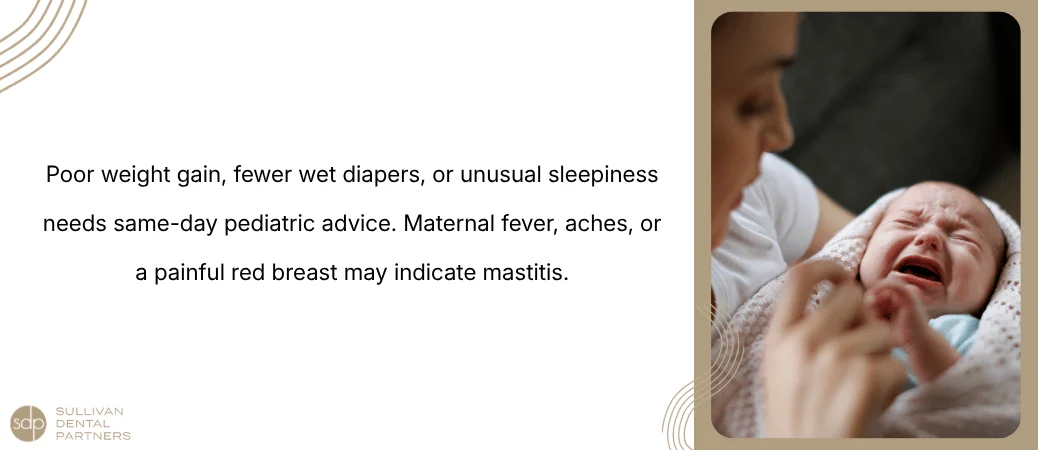
Slow weight gain, few wet diapers, or a baby who seems sleepy and hard to rouse needs same-day contact with your pediatrician. These signal that your baby may not be getting enough milk, whatever the underlying cause.
Gas, fussiness, colic-like crying, and reflux symptoms have many possible explanations. Air swallowed through a broken seal is one of them, though these symptoms alone do not confirm a tongue-tie.
Call your provider promptly if you develop a fever, flu-like aches, or a red, painful wedge on your breast. Those are signs of possible mastitis and need treatment.
Get a Feeding Assessment Before Deciding on Treatment
A hands-on feeding assessment should come before any decision about a procedure. Someone needs to watch your baby feed from start to finish, examine tongue function, and rule out simpler explanations first.
Who Can Assess a Possible Tongue-Tie?
Different professionals contribute different pieces:
| Who | What they do |
| IBCLC / lactation consultant | Watches a full feed, assesses oral function, adjusts positioning and attachment, tracks milk transfer |
| Pediatrician | Monitors weight and growth, rules out medical causes, makes or confirms the diagnosis |
| Midwife | Often the first to spot a tie at newborn checks |
| LLL Leader | Free peer support, practical positioning help, referral guidance |
| ENT or pediatric dentistry | Performs the release when it’s indicated |
An IBCLC assesses feeding and oral function, while diagnosing a tie and deciding on release is a medical decision made with your pediatrician, ENT, or a dental provider.
Practices that offer lip and tongue tie treatment work alongside your feeding team rather than replacing it.
What a Functional Tongue-Tie Evaluation Should Include
A thorough evaluation covers more than a glance under the tongue. Expect the provider to:
- Take a full history of your pain, feed length, and your baby’s output
- Weigh your baby before and after a feed to estimate milk transfer
- Feel inside your baby’s mouth to check tongue lift, extension, and cupping
- Watch a complete feed and try adjustments in real time
- Look at your nipple shape immediately after unlatching
If a provider recommends a release without watching your baby feed, it is reasonable to ask for that step first.
Other Reasons Breastfeeding Can Be Difficult
Most breastfeeding problems resolve with better positioning and attachment. Small changes in how you hold your baby often fix pain within a feed or two.
Other common causes include engorgement making the breast too firm to latch onto, oversupply causing gulping and pulling off, low milk supply, flat or inverted nipples, a strong letdown, or a baby recovering from a difficult birth with tight neck or jaw muscles.
What Can Help While You Seek Support?
While you wait for an appointment, three things protect your feeding relationship: better positioning, maintaining your milk supply, and healing your nipples. None of these require a diagnosis to start.

Improving Positioning and Attachment
Try biological nurturing, the laid-back position where you recline and let your baby lie tummy-down on your chest.
Gravity helps your baby dig in deeper, and many babies latch better without being held into place.
Aim your nipple toward your baby’s nose so they tip their head back and open wide. Wait for that wide gape before bringing them on.
Different feeding positions suit different babies. Side-lying, laid-back, and the koala hold each change the angle of the tongue against the breast.
Breast compression during a feed keeps milk flowing when your baby’s suck weakens, which helps babies who tire out quickly.
Protecting Milk Supply and Relieving Breast Fullness
If your baby isn’t removing milk well, add pumping or hand expression after feeds. This protects your supply while the underlying issue gets sorted out.
For engorgement, reverse pressure softening helps: press your fingertips gently around the base of the nipple for 60 seconds to move fluid back and soften the areola so your baby can latch. A softer breast is easier for a tongue-tied baby to take.
A nursing supplementer, a thin tube taped alongside your nipple, lets your baby receive expressed milk or formula at the breast. Supplementing when it’s medically needed is not a failure.
Caring for Sore or Damaged Nipples
Damaged nipples heal fastest with moist wound healing. Apply a thin layer of modified lanolin after feeds, or use hydrogel pads for cooling relief between feeds.
Express a few drops of your own milk and rub it in. Let nipples air-dry when you can.
If a crack worsens, develops yellow crusting, or feels increasingly painful, contact your provider. Bacterial infection needs treatment.
When a Tongue-Tie Release May Be Considered
A release is considered when a functional assessment confirms restricted tongue movement, feeding problems persist despite good positioning support, and continuing to breastfeed is a goal for your family.
It is a decision made with your care team, not a routine next step after a diagnosis.
Frenotomy, Frenectomy, and Frenulotomy: What the Terms Mean
The words overlap, which causes confusion. Here’s the plain-English breakdown:
- Frenotomy (also called frenulotomy or lingual frenotomy): a simple snip of the frenulum with sterile scissors, taking a few seconds
- Frenectomy: removal of the frenulum tissue, sometimes done with a laser
Providers use these terms differently, so ask exactly what is planned, what tool will be used, and what aftercare they expect.
What to Expect During and After a Lingual Frenotomy
The procedure is quick. Your baby is swaddled, the provider lifts the tongue, and the tissue is divided in a few seconds. Anesthetic is generally not used for a simple scissors frenotomy.
You feed your baby right afterward, which soothes them and helps stop any minor bleeding. A small white or yellow patch under the tongue is normal healing for a week or so.
Some providers recommend stretching exercises afterward. Recommendations vary between providers, so ask for clear written instructions and how long to continue.
Why Follow-Up Feeding Support Still Matters
Improvement is not always immediate. Some parents notice relief at the very next feed, while others need days or weeks as their baby learns a new way to use the tongue.
Book a follow-up with your lactation consultant for after the procedure. Your baby has been compensating for weeks, and old habits need retraining.
Keep tracking weight gain and your own comfort. If nothing changes after a few weeks of support, that’s useful information too, and it points toward looking at other causes.
Finding the Right Support for Comfortable, Effective Feeding

Breastfeeding struggles are worth taking seriously, and you deserve real answers rather than being told to push through the pain. Start with someone who will sit with you through a whole feed.
An IBCLC or lactation consultant can assess positioning, oral function, and milk transfer. Your pediatrician tracks growth and rules out other medical causes.
A midwife or LLL Leader offers early, practical help that costs nothing.
If a release turns out to be the right step, it works best as one part of a plan that includes ongoing feeding support. If it isn’t, you’ll have a clearer picture of what will help.
Call your provider today if your baby isn’t gaining weight, has fewer than six wet diapers a day after the first week, or if you have a fever alongside breast pain.
Frequently Asked Questions
How can I tell if a tongue-tie is affecting breastfeeding?
Look for a pattern rather than a single sign: persistent nipple pain, clicking, repeated slipping off the breast, very long feeds, and slow weight gain together suggest a functional problem.
A trained provider watching a full feed can tell you whether restricted tongue movement is the cause. Appearance under the tongue alone does not answer the question.
Can a shallow latch be caused by a tongue-tie?
Yes, restricted tongue movement can prevent a baby from drawing enough breast tissue into the mouth.
A shallow latch has many other causes too, including positioning, engorgement, and flat or inverted nipples. Trying position adjustments with a lactation consultant is the sensible first step.
What are the first signs of a tongue-tie in a newborn?
Early signs include trouble latching or staying latched, a tongue that doesn’t lift or move side to side, a heart-shaped tongue tip when crying, and nipple pain from the first feeds.
Midwives sometimes spot a tie at the newborn check. Many ties are found later, once feeding problems appear.
Does every baby with a tongue-tie need a frenotomy?
No. Many babies with a tongue-tie latch and feed well, and treatment is reserved for cases where feeding problems persist despite good positioning and attachment support.
Some babies simply grow out of the restriction.
Is 4 months too late for a tongue-tie release?
Four months is not too late, and releases are performed on older babies and children when feeding or oral function problems continue.
Older babies may need more retraining afterward because they have compensated for longer. Discuss timing with your pediatrician and the provider who would perform the release.
How soon can breastfeeding improve after a tongue-tie release?
Some parents notice less pain at the very next feed, while others see gradual change over several days or weeks. Your baby needs time to learn a new tongue pattern after months of compensating.
Schedule follow-up lactation support within a few days to help that transition along.