Missing teeth affect more than just your smile. They impact how you eat, speak, and feel about yourself every day.
When you’re looking at tooth replacement options, two popular choices stand out: dental implants and snap-in dentures.
Dental implants offer permanent, fixed stability and function like natural teeth, while snap-in dentures provide a removable option that improves over traditional dentures with better security than adhesive-based alternatives.
Each solution has different benefits when it comes to comfort, daily care, and long-term oral health.
Understanding the real differences between these options helps you make a choice that fits your lifestyle and budget.
This guide breaks down what matters most: how stable they feel, how comfortable they are to wear, what maintenance they need, and how they protect your jawbone over time.
Key Takeaways
- Dental implants provide permanent stability and bone preservation but cost more upfront than snap-in dentures
- Snap-in dentures attach to implants for better security than traditional dentures while remaining removable for cleaning
- Your choice depends on your budget, jawbone health, and whether you prefer a fixed or removable solution
Table of Content
- Understanding Dental Implants and Snap-In Dentures
- Placement Procedures and Technologies
- Everyday Experience: Comfort and Function
- Longevity and Impact on Oral and Jawbone Health
- Maintenance and Daily Care Requirements
- Cost Considerations and Choosing the Right Solution
- Frequently Asked Questions
Understanding Dental Implants and Snap-In Dentures
Both dental implants and snap-in dentures offer solutions for missing teeth, but they work in different ways and provide distinct levels of stability.
Understanding how each option functions helps you make an informed choice about which tooth replacement method fits your needs.
What Are Dental Implants?
Dental implants are permanent tooth replacements that start with metal posts surgically placed into your jawbone. These implant posts act as artificial tooth roots that fuse with your bone over time.
Once the posts integrate with your jawbone, your dentist attaches abutments to the top of each post. An implant crown then gets mounted on each abutment to complete the tooth replacement.
This process creates a stable, long-lasting solution that functions like natural teeth.
Dental implants require enough bone material to support the posts. If you’ve experienced bone loss from gum disease or tooth loss, you might need bone grafting before getting implants.
The entire process takes several months because your bone needs time to grow around the posts and secure them in place.
How Snap-In Dentures Work
Snap-in dentures, also called overdentures or implant-retained dentures, combine features of traditional dentures with dental implant technology.
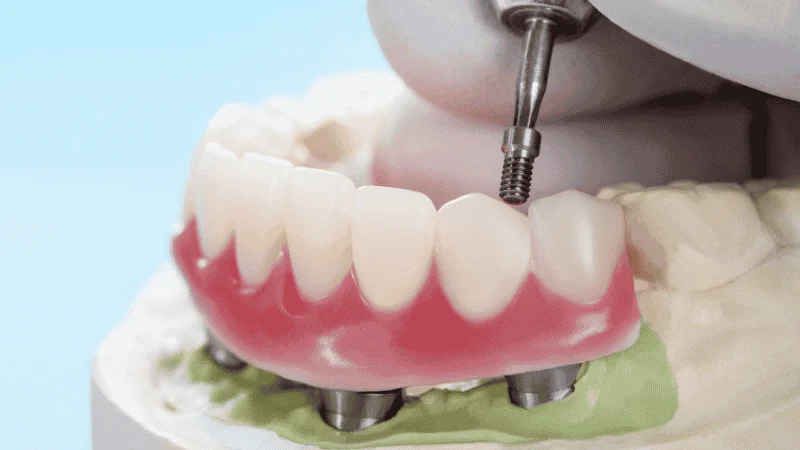
Instead of using adhesive to stay in place, these dentures snap onto a few strategically placed dental implants or attachments.
Your dentist places two to four implant posts in each jaw to support the denture. The denture base has locator attachments that click onto the posts, creating a secure connection.
You can remove snap-in dentures for cleaning, unlike permanent implant crowns.
This design provides more stability than conventional removable dentures while costing less than replacing every tooth with individual implants.
Implant overdentures stay firmly in place during eating and speaking but still allow you to take them out when needed.
Key Differences and Similarities
Permanence sets these options apart most clearly. Dental implants with crowns stay fixed in your mouth permanently, while snap-in dentures can be removed daily for cleaning.
Number of implants varies significantly between the two. Individual implants require one post per missing tooth, but implant-supported dentures only need two to four posts per arch.
Maintenance requirements differ based on design. Implants need the same care as natural teeth; brushing and flossing daily. Snap-in dentures require removal for cleaning and should soak overnight in water or cleaning solution.
Both options prevent bone loss better than traditional dentures because the implant posts stimulate your jawbone. Both also provide improved chewing ability compared to adhesive-based dentures.
Tooth Replacement Options Compared
| Feature | Dental Implants | Snap-In Dentures | Traditional Dentures |
| Removable | No | Yes | Yes |
| Implants needed | One per tooth | 2-4 per arch | None |
| Bone stimulation | High | Moderate | None |
| Stability | Highest | High | Low to moderate |
| Daily maintenance | Brush and floss | Remove and clean | Remove and clean |
| Adhesive required | No | No | Yes |
The choice between these tooth replacement methods depends on your bone density, budget, and preference for removable versus permanent solutions.
Implant-supported overdentures offer a middle ground between full implant reconstruction and conventional dentures, providing better stability than traditional dentures without requiring an implant for each missing tooth.



Placement Procedures and Technologies
Both treatment options require different surgical approaches and planning methods. Dental implants involve more complex surgery and healing time, while snap-in dentures use fewer implants with simpler attachment systems.
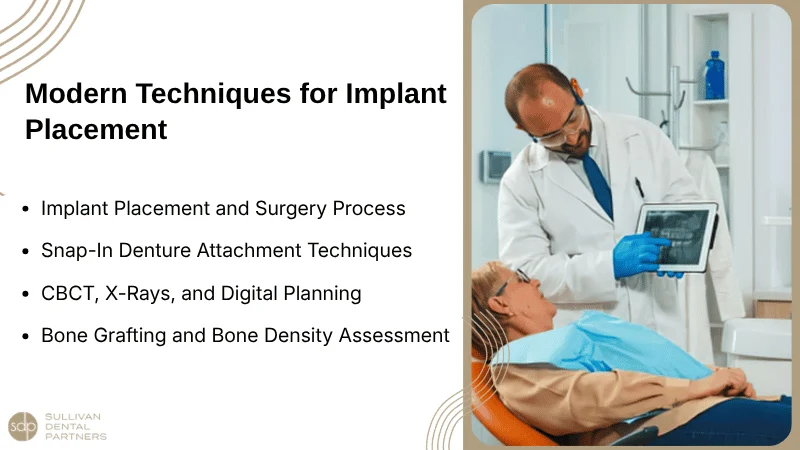
Implant Placement and Surgery Process
Your oral surgeon will place titanium posts directly into your jawbone during implant surgery. The procedure typically requires local anesthesia or sedation depending on how many implants you need.
For full-arch dental implants, your surgeon places four to six posts per arch. The surgical process takes two to three hours per arch.
After placement, you’ll wait three to six months for osseointegration to occur, which is when the bone fuses to the implant surface.
Your surgeon attaches an implant abutment to each post once healing is complete. These abutments connect the implant to your final restoration. The healing process is critical because it determines how stable and long-lasting your implants will be.
Snap-In Denture Attachment Techniques
Snap-in dentures require only two to four implants per arch, making the surgery shorter and less involved. Your oral surgeon places these implants in strategic locations where you have the best bone density and bone volume.
The attachment system uses either ball-and-socket connectors or bar attachments. Ball attachments have a rounded top on each implant that fits into sockets built into your denture.
Bar attachments connect multiple implants with a metal bar, and your denture clips onto this bar.
You can remove your snap-in denture daily for cleaning. The attachment system holds your denture firmly during eating and speaking but releases when you pull upward with steady pressure.
CBCT, X-Rays, and Digital Planning
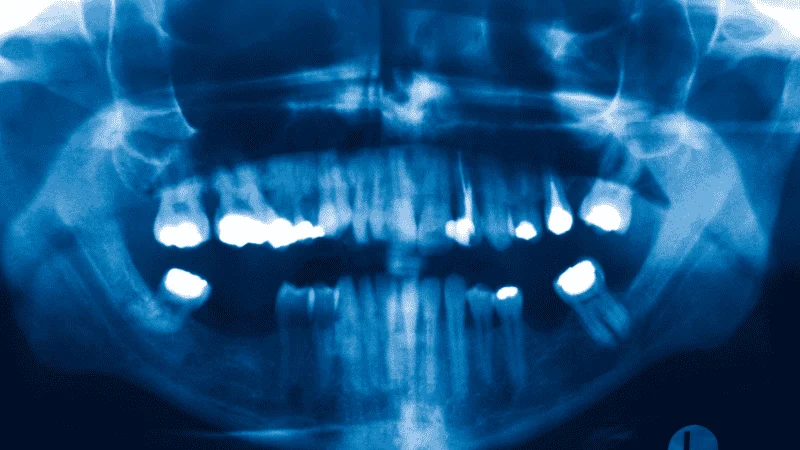
Your dentist uses cone beam computed tomography (CBCT) scans to create 3D images of your jaw. These scans show your bone density, nerve locations, and sinus cavities.
Standard X-rays provide additional views of your tooth roots and existing bone structure.
Digital planning software helps your surgeon map out exact implant positions before surgery. This technology improves accuracy and reduces surgical time.
Your surgical team can identify potential problems with bone volume or anatomical structures before starting the procedure.
Bone Grafting and Bone Density Assessment
You may need bone grafts if you lack sufficient bone volume for stable implant placement. Your surgeon evaluates your bone density using CBCT scans and determines whether grafting is necessary.
Common grafting materials include your own bone, donor bone, or synthetic materials. The graft fills areas where bone has deteriorated and provides a solid foundation for implants.
You’ll need three to six months of healing time after bone grafting before implant surgery can proceed.
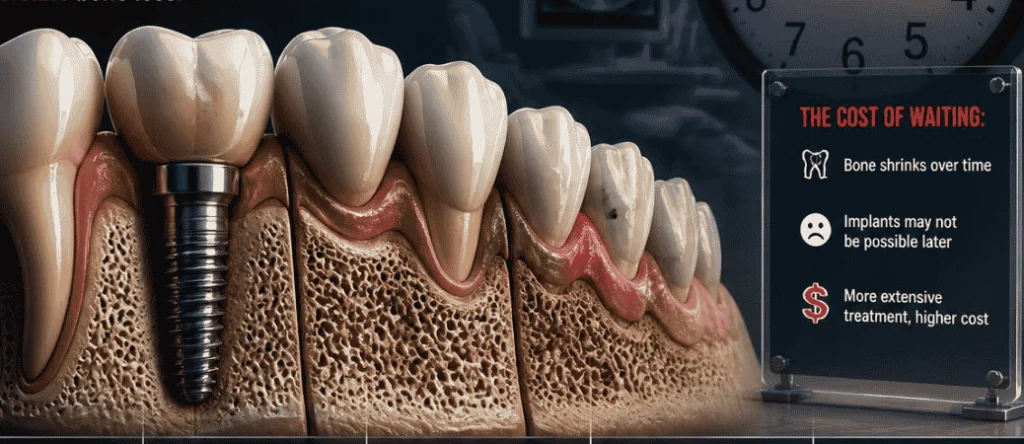
Bone preservation is easier to maintain when you still have some natural teeth. Once teeth are removed, your jawbone begins to shrink without the stimulation from tooth roots. Implants help prevent this bone loss by mimicking natural tooth roots.
Everyday Experience: Comfort and Function
Fixed implant bridges stay locked in place and restore up to 90% of natural bite force, while snap-in dentures improve stability over traditional complete dentures but still rest on gums and deliver lower chewing strength.
Speech clarity, taste sensation, and facial support also differ between the two options.
Denture Stability and Implant Retention
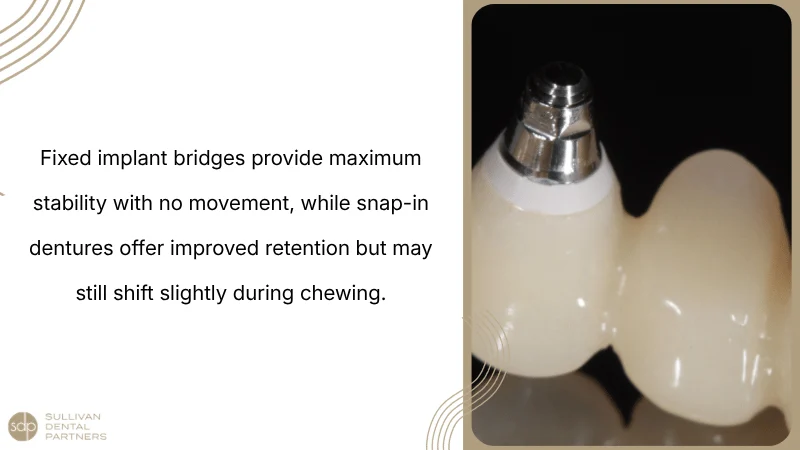
Fixed implant bridges anchor directly into your jawbone through titanium posts. They do not move when you talk, laugh, or bite down hard. You get the same stability as natural teeth because the implants fuse with bone.
Snap-in dentures clip onto two to four implants using ball or locator attachments. This system gives better denture stability than traditional complete dentures, but the denture base still rests on your gums.
You may feel slight movement when biting sticky or hard foods.
An implant-supported overdenture reduces slipping and improves confidence compared to plates held by suction alone.
Yet it cannot match the rock-solid retention of a full-arch restoration that screws directly onto implants. If you want zero movement, fixed implant bridges deliver that security every day.
Bite Force, Chewing Strength, and Chewing Efficiency
Your natural teeth generate around 200–250 pounds per square inch of bite force. Fixed implant bridges restore 80–90% of that power because they transfer chewing loads straight to bone. You can eat apples, steak, and crusty bread without worry.
Snap-in dentures improve chewing efficiency over traditional dentures but usually deliver only 20–50% of natural bite strength. The acrylic base absorbs some pressure, which limits how hard you can bite. Tough or chewy foods remain challenging.
All-on-x dental implants support a fixed full-arch bridge on just four posts per jaw. This design maximizes bite strength while reducing surgery time and cost compared to placing six or eight implants.
Many patients report near-natural chewing within weeks of healing.
Chewing strength directly affects your diet and nutrition. If you rely on softer foods now, an overdenture may meet your needs. If you want to enjoy a wide variety of textures, fixed implant bridges give you the most chewing power.
Impact on Speech and Taste
Fixed implant bridges sit like natural teeth and leave your palate open. Your tongue moves freely, so you pronounce sounds clearly from the start. You also taste food fully because nothing blocks the roof of your mouth.
Snap-in dentures include an acrylic flange that can cover part of your palate, depending on the design. That coverage may muffle taste and make certain sounds harder to form.
You might need practice to speak clearly, especially with “s,” “sh,” and “f” sounds.
Adjustments to the denture shape can reduce speech issues over time. Many people adapt within a few weeks, but fixed options eliminate the learning curve.
If clear communication and enjoying flavors matter to you, consider how much palate coverage you can accept.
Aesthetics and Facial Support
Implant bridges preserve jawbone health because chewing forces stimulate bone through the implant posts. Healthy bone maintains facial contours and prevents the sunken look that leads to facial collapse over time.
Snap-in dentures slow bone loss compared to traditional plates but do not stop it entirely. The denture base rests on gums and does not transfer enough force to bone.
You may need periodic relines as your jaw shrinks, and facial support can diminish over years.
Both options restore your smile line and fill out lips for a natural appearance. Fixed bridges often use porcelain or zirconia teeth that look highly realistic.
Snap-in dentures use acrylic teeth that still appear natural but may show wear sooner. Your quality of life improves with either choice, yet long-term stability and comfort favor fixed implants for preserving facial structure.
Longevity and Impact on Oral and Jawbone Health
Dental implants actively stimulate your jawbone like natural tooth roots, while snap-in dentures only partially address bone loss.
Your choice affects not just how long your restoration lasts but also your facial structure and long-term gum health.
Bone Loss Prevention and Bone Preservation
Dental implants are the only tooth replacement option that can actually prevent bone loss in your jaw. When you lose teeth, your jawbone starts to shrink because it no longer gets the stimulation it needs from natural tooth roots.
Implants act just like those roots by transferring chewing forces directly into your jawbone.
This process keeps your bone strong and healthy for years. Studies show that dental implants maintain about 98% of bone volume in the area where they’re placed.
Snap-in dentures offer some bone preservation benefits, but they’re limited. The 2 to 4 implants used to hold your denture only stimulate the bone where they’re placed.
The rest of your jawbone still loses volume over time because there’s no direct stimulation in those areas.
Traditional dentures provide no bone preservation at all. Your entire jawbone continues to shrink year after year, which is why dentures need to be relined or replaced every 5 to 7 years.
Jawbone Loss and Facial Structure
Jawbone loss doesn’t just affect your mouth. It changes the shape of your face in ways that make you look older than you are.
When your jawbone shrinks, your lower face gets shorter. Your chin moves closer to your nose, creating deep wrinkles around your mouth. Your lips lose support and start to look thin and sunken.
Full dental implants protect your facial structure by maintaining your jawbone density. Your face keeps its natural shape and proportions for decades.
With snap-in dentures, you’ll experience some jawbone loss in areas without implants. This means gradual changes to your facial appearance, though not as severe as with traditional dentures.
You might notice your lower face slowly losing height over 10 to 15 years.
The impact on jawbone health affects your daily life too. As bone loss continues, your snap-in denture may fit less securely over time.
Risks of Peri-Implantitis and Other Complications
Peri-implantitis is an infection around dental implants that damages the surrounding bone and gum tissue. It happens when bacteria build up around the implant, similar to gum disease around natural teeth.
Your oral hygiene habits directly affect your risk. If you don’t brush and floss properly around your implants, plaque accumulates and causes inflammation.
Studies show that peri-implantitis affects 10% to 20% of patients within 5 to 10 years after implant placement.
You can prevent this complication with good daily care. Brush twice a day, use interdental brushes or water flossers to clean around implants, and see your dentist every 6 months for professional deep cleanings.
Snap-in dentures have their own maintenance challenges. Because you remove them daily, bacteria can grow on both the denture and your gums if you don’t clean them thoroughly. Poor cleaning leads to gum inflammation and infections.
The implants supporting your snap-in denture can also develop peri-implantitis if you neglect your oral hygiene. You need to clean around the implant attachments every time you remove your denture.
Smoking increases your risk of complications with both options. It slows healing after surgery and makes infections more likely throughout the life of your implants.
Maintenance and Daily Care Requirements
Both options need regular cleaning and checkups, but snap-in dentures require removal and soaking while implants stay in place and get brushed like natural teeth. You’ll also face different long-term maintenance needs depending on which option you choose.
Cleaning Snap-In Dentures vs Implants
Snap-in dentures must be removed daily for proper cleaning. You need to take them out at night and soak them in a denture cleaning solution. This helps remove bacteria and food particles that build up during the day.
Rinse your snap-in dentures after every meal when possible. Use a soft-bristled brush designed for dentures to gently scrub all surfaces. Never use regular toothpaste because it’s too harsh and can scratch the denture material.
Dental implants with fixed teeth stay in your mouth all the time. You clean them just like natural teeth by brushing twice daily. This makes oral hygiene simpler since you don’t need to remove anything or use special soaking solutions.
Daily Brushing, Flossing, and Interdental Brushes
For snap-in dentures:
- Brush the denture with denture cleaner twice daily
- Clean your gums, tongue, and implant attachments with a soft brush
- Rinse your mouth before putting dentures back in
For fixed implants:
- Brush twice daily with a soft-bristled toothbrush
- Floss once daily using specialized floss threaders
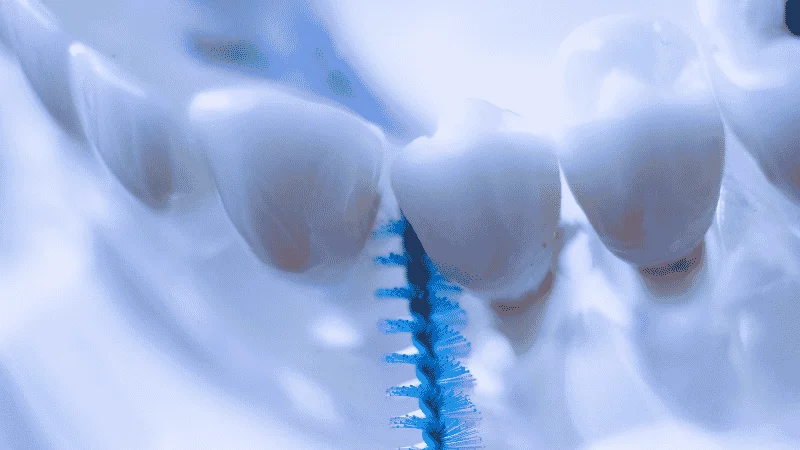
- Use interdental brushes to clean around implant posts
Water flossers work well for both options. They help remove food debris from hard-to-reach areas around implant attachments and between artificial teeth.
Adjustments, Relines, and Component Replacement
Snap-in dentures need adjustments every few months as your jaw bone changes shape. The clips or attachments that connect to implants wear out over time. You’ll need replacement clips every 1-2 years.
Relines are needed every 2-3 years for removable prostheses. Your dentist adds new material to help the denture fit better against your gums. The entire denture typically needs replacement every 5-10 years.
Fixed implants rarely need adjustments once placed. The crown or bridge might need replacement after 10-15 years due to normal wear. Individual screws or abutments occasionally loosen and require tightening during regular checkups.
Cost Considerations and Choosing the Right Solution
Upfront costs vary widely between options, but long-term expenses and your jaw health play equally important roles. The right choice depends on your budget, bone condition, and daily life needs.
Initial Investment and Long-Term Value
Dental implants typically cost more at the start. A single implant with crown ranges from $3,000 to $6,000, while full-arch fixed implants can reach $20,000 to $50,000 per arch. You pay for surgery, titanium posts, healing time, and custom prostheses.
Snap-in dentures require fewer implants (usually two to four per arch) which lowers the initial price to roughly $5,000 to $15,000 per arch. Snap-in denture costs vary based on implant type, lab quality, and post-op care.
Over 10 to 20 years, fixed implants often deliver better value. You replace crowns less often and preserve bone, which cuts future reconstruction needs.
Snap-in dentures need relines, rebases, or replacement every few years, plus new attachment inserts. Those recurring costs can add up to match or exceed the lifetime expense of implants.
Traditional dentures cost least upfront ($1,000 to $3,000 per arch) but offer no implant support and may need more frequent replacement.
Suitability: Candidate Factors and Bone Quality
Your jawbone density decides which option works. Dental implants require adequate bone height and width for the titanium post to fuse securely.
If you have significant bone loss from missing teeth or gum disease, you may need a bone graft or sinus lift before implant placement.
Snap-in dentures need less bone support because only a few implants anchor the prosthesis. That makes them a practical choice if you have moderate bone loss but still want better stability than traditional dentures.
Key candidate factors:
- Overall health: Uncontrolled diabetes, smoking, or immune disorders can slow healing and raise implant failure risk.
- Oral hygiene: Both options demand daily cleaning. Poor habits increase infection and complication rates.
- Lifestyle: If you want a fixed solution you never remove, implants suit you. If you prefer nightly removal for easier cleaning, snap-ins fit better.
Your dentist will use X-rays or CBCT scans to measure bone and recommend grafting if needed.
Making Your Final Decision
Weigh upfront budget against long-term costs and daily comfort. Fixed implants offer the highest bite force, preserve bone, and feel most like natural teeth.
Snap-in dentures give improved stability over traditional options at a lower starting price, but they require more maintenance and replacement over time.
Ask your dentist these questions:
- How much bone do I have, and will I need grafts?
- What are the total costs for each option over 15 years?
- How often will I need adjustments, relines, or replacements?
- Which solution matches my chewing and speech goals?
Schedule a consultation to review imaging, discuss your health history, and see which prosthesis design fits your mouth.
Choosing between dentures and implants should happen carefully with professional guidance. Most practices offer payment plans or financing to spread costs over time.
Frequently Asked Questions
Fixed implants offer the strongest stability, while snap-in dentures cost less up front but need more frequent maintenance.
Most complications with snap-ins involve loosening attachments and gum soreness that regular adjustments can prevent.
Which option feels more stable for eating and speaking: implant-supported teeth or snap-in dentures?
Implant-supported teeth feel more stable because they anchor directly into your jawbone. You can bite into firm foods like apples or corn on the cob without worrying about movement.
Speaking feels natural since the restoration sits like your original teeth.
Snap-in dentures attach to implants but still rest on your gums. They stay in place much better than traditional dentures, yet you might notice some movement when biting hard foods.
Your tongue needs to adjust to the denture base, which can affect certain sounds at first.
If you want the closest feel to natural teeth, fixed implants provide better stability for daily activities. Snap-ins work well if you prefer something removable that still offers improved security over regular dentures.
What’s the typical cost difference between snap-in dentures and dental implants?
Dental implants cost more at the start because you pay for surgery, titanium posts, and custom crowns or bridges. A single implant and crown typically runs $3,000 to $6,000. Full-arch fixed implants can range from $20,000 to $50,000 per arch.
Snap-in dentures use fewer implants; usually two to four per arch; and a removable denture base. Upfront costs typically fall between $5,000 and $15,000 per arch. You save money initially compared to full fixed implants.
Over time, snap-ins need relines, repairs, and replacement dentures every few years. Those recurring costs add up. Fixed implants require less frequent part replacement, so the lifetime cost gap narrows or even reverses after 10 to 20 years.
How does daily cleaning and long-term maintenance compare between snap-in dentures and implant-supported teeth?
You brush and floss fixed implant teeth just like natural teeth. Use interdental brushes or a water flosser to clean around crowns and under bridges. Visit your dentist every few months for professional cleaning and X-rays to check bone health.
Snap-in dentures require you to remove them daily for cleaning. You scrub the denture, clean the attachment housings, and brush the implant posts in your mouth. Most people soak dentures overnight to prevent warping.
Dentures also need periodic relines as your gums and bone change shape. Attachment parts wear out and need replacement every one to three years.
Fixed implants avoid those frequent adjustments but demand careful daily hygiene to prevent infection around the implant.
What are the most common problems people run into with snap-in dentures, and how can they be prevented?
Loosening attachments cause the most complaints. The nylon inserts or clips that hold the denture in place wear down with repeated snapping on and off.
Replace them as soon as you notice reduced grip to prevent the denture from shifting during meals.
Sore spots develop when the denture rocks or presses unevenly on your gums. Schedule adjustments with your dentist to reshape the base and relieve pressure points. Regular relines keep the fit snug as your bone changes.
Food can trap around the implant posts and attachment housings. Clean thoroughly every day with a soft brush and rinse. Poor hygiene leads to inflammation and infection around the implants, which can loosen them over time.
Bone loss under the denture base happens faster than with fixed implants. The denture presses on your gums instead of directly loading the bone through implants.
Regular checkups let your dentist monitor bone health and plan relines or additional implants if needed.
How do snap-in dentures compare with All-on-4 in terms of comfort, fit, and overall cost?
All-on-4 uses four angled implants to support a fixed full-arch bridge that you cannot remove. It feels more like natural teeth because it anchors firmly and avoids a bulky denture base. You clean it with brushing and flossing, not by taking it out.
Snap-in dentures attach to two to four implants but remain removable. They still have a denture base that covers your palate or gums. Comfort improves over traditional dentures, yet the base can feel bulkier than an All-on-4 bridge.
All-on-4 costs more up front; often $20,000 to $30,000 per arch; because you get a fixed prosthesis custom-made to the implants. Snap-ins typically run $5,000 to $15,000 per arch.
Maintenance costs differ too: All-on-4 needs less frequent replacement, while snap-ins require periodic denture renewals and attachment part changes.
If you want a permanent feel and the strongest bite, All-on-4 delivers better function. If you prefer a lower starting price and the ability to remove your teeth for cleaning, snap-ins offer a middle ground.
Are snap-in dentures a good choice if you want something more secure than traditional dentures but less involved than full implants?
Yes, snap-in dentures fit that middle space. They clip onto a few implants or attachments, so they stay put much better than dentures held by suction or adhesive. You avoid the embarrassment of slipping teeth during conversation or meals.
The surgery is simpler than full fixed implants because you place only two to four implants instead of six to eight. Healing time is shorter, and total treatment time shrinks. You still get to remove the denture for cleaning, which some people prefer.
Snap-ins do not preserve bone as well as fixed implants. The denture base rests on gums and transfers less load to the bone. Over time, you may need relines or even more implants if bone loss continues.
If you want better stability without the cost and complexity of a full implant arch, snap-in dentures deliver noticeable improvement. They work especially well if you already wear traditional dentures and want an upgrade that feels more secure.