Getting a single dental implant after teeth shifting may still be possible, even if neighboring teeth have moved into the empty space.
However, a narrowed gap can affect implant placement, root clearance, and the final crown’s fit.
Your dentist must evaluate the available space, surrounding bone, and bite to determine whether orthodontic treatment or another approach is needed before replacing the missing tooth.
Your tooth replacement also needs enough height to meet the tooth in the opposite jaw comfortably. Even when an implant fits into the bone, its crown still needs room for a natural shape and a balanced bite.
When you discuss a single tooth implant with Sullivan Dental Partners, ask whether the existing space supports the finished tooth. That question helps you understand whether preparation is needed before placement.
What Determines Whether There Is Enough Room?
Your available space includes the width between adjacent teeth, clearance between their roots, and vertical space needed for the final restoration. Tooth migration affects each of these areas differently.
Why the Visible Gap Does Not Tell the Whole Story
The visible gap shows the space between the crowns of neighboring teeth, but it does not reveal how their roots are positioned beneath the gums.
Below that opening, neighboring roots might lean toward the planned implant site.
You might also have enough width at the gumline but too little room at the chewing surface. Your dentist checks tooth alignment and bite alignment together because the replacement crown must fit throughout that space.
How Dentists Measure Crown Space and Root Clearance
Your assessment starts with an exam, bite checks, and dental images. A scan or model of your teeth helps your team plan the replacement crown’s size and shape.
Your dentist uses X-rays and, when appropriate, a three-dimensional CBCT scan to assess root positions and surrounding bone.
You need enough clearance along the proposed implant’s path, including areas hidden beneath the gums.
Ask your dentist to show you the planned crown alongside the root images. This makes it easier to see why implant placement sometimes requires more room than the visible opening suggests.
How an Overerupted Opposing Tooth Affects Bite Clearance
If your missing tooth has gone unreplaced, the opposing tooth may move farther into the gap. Your dentist calls this overeruption or supraeruption.
That movement reduces the height available for your replacement tooth. Your dentist checks your occlusion, meaning how your upper and lower teeth meet, both when you close and when you move your jaw sideways.
How Can Dentists Restore Space Before an Implant?
Your dentist and orthodontist can use controlled tooth movement to reopen a narrowed space and improve root positions. Your planned crown guides how much correction you need.
When Braces or Clear Aligners Can Reopen the Gap
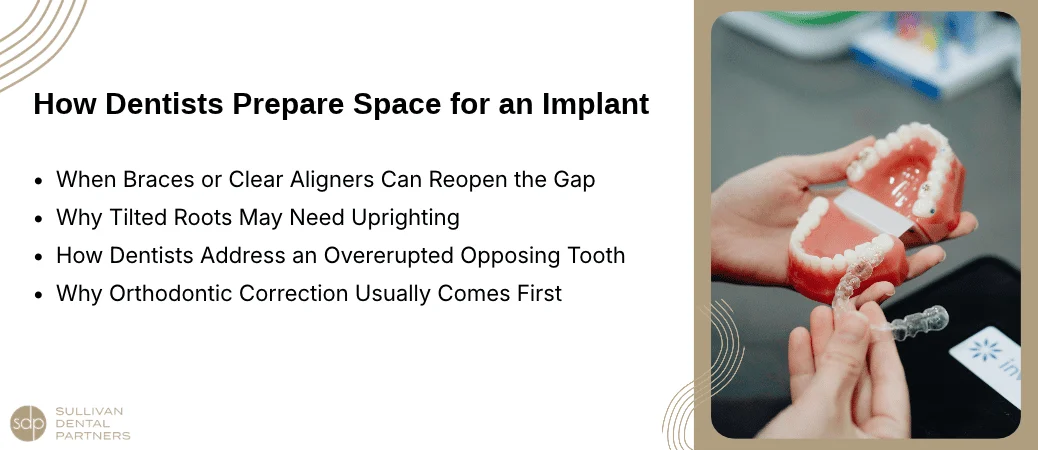
You may need orthodontic treatment to move drifting teeth away from the missing-tooth site. Treatment might focus on a limited area or involve more teeth when your bite also needs adjustment.
Your choice between clear aligners and traditional braces should match the movement required. Clear aligners require consistent wear, while fixed braces give your orthodontist another way to control difficult movements.
Before starting, ask which teeth need to move and how your team will confirm that enough room has been created.
Why Tilted Roots May Need Uprighting
Your teeth need suitable root positions as well as an open-looking gap. Moving a crown away from the site does not automatically provide clearance deeper in the jaw.
If a neighboring tooth is tilted, your orthodontist plans movement that brings its root into a better position. Improving tooth alignment and oral health also includes checking whether the corrected area is easier for you to clean.
Your team checks root positions during treatment before approving the implant site.
How Dentists Address an Overerupted Opposing Tooth
Your treatment for an overerupted tooth depends on how far it has moved and its current condition. Orthodontic intrusion moves the tooth back toward its supporting bone to recover bite space.
For a small interference, your dentist might recommend a limited adjustment to the chewing surface.
Larger changes require careful planning to protect the tooth; substantial reshaping sometimes involves a crown or other restorative care.
You should receive an explanation of how much tooth movement or reshaping is proposed before treatment begins.
Why Orthodontic Correction Usually Comes First
Your natural teeth move through living tissues during orthodontic treatment. Once integrated with your jawbone, dental implants stay fixed and do not move with braces or aligners.
Your dental team should establish sufficient space and appropriate root positions before implant placement.
At Sullivan Dental Partners, Dr. Richard Sullivan IV can help patients evaluate implant treatment options and coordinate restorative planning with orthodontic care when needed.
After orthodontic correction, your team may recommend a retainer or temporary appliance to maintain the space until the implant restoration is completed.
Why Should an Implant Not Be Squeezed Into a Tight Gap?
Your implant must be positioned to protect adjacent structures and support a usable crown. In implant dentistry, inadequate restorative space creates risks for the finished tooth’s stability, appearance, and contours.
How Inadequate Clearance Can Harm Neighboring Roots
If your implant is placed too close to a neighboring root, the supporting bone and tooth are at risk. Direct injury during placement also threatens the tooth’s health.
Your dentist plans clearance to avoid those problems. Root canal treatment becomes relevant only if a neighboring tooth develops pulp damage or another condition that requires it; you should never expect it as a routine step in making an implant fit.
When a Narrower Implant May Be Appropriate
A narrow-diameter implant may be considered in selected situations, depending on the tooth being replaced, available bone, neighboring root positions, and anticipated biting forces.
A smaller implant still needs safe root clearance. You also need a crown with suitable proportions, so reducing implant width does not solve every tight-space problem.
Ask why the proposed implant size suits your particular site and chewing load.
Why the Final Crown Must Fit the Bite
Your final crown needs enough width and height to function comfortably. A cramped or poorly shaped crown creates difficulty with bite contacts and daily cleaning.
Your dentist plans how the crown will meet the opposing tooth and contact its neighbors. Access for floss or another cleaning aid belongs in that plan, since maintaining your dental implant requires cleaning around the gumline.
Before approving treatment, ask how your finished crown will fit and how you will clean beneath its contact points.
What if Reopening the Space Is Not the Best Option?
You have other ways to address a single missing tooth when reopening the gap would require treatment you do not want or would compromise your oral health.
Your dentist should explain which options fit the space and the condition of your remaining teeth.
When a Dental Bridge May Be Worth Considering
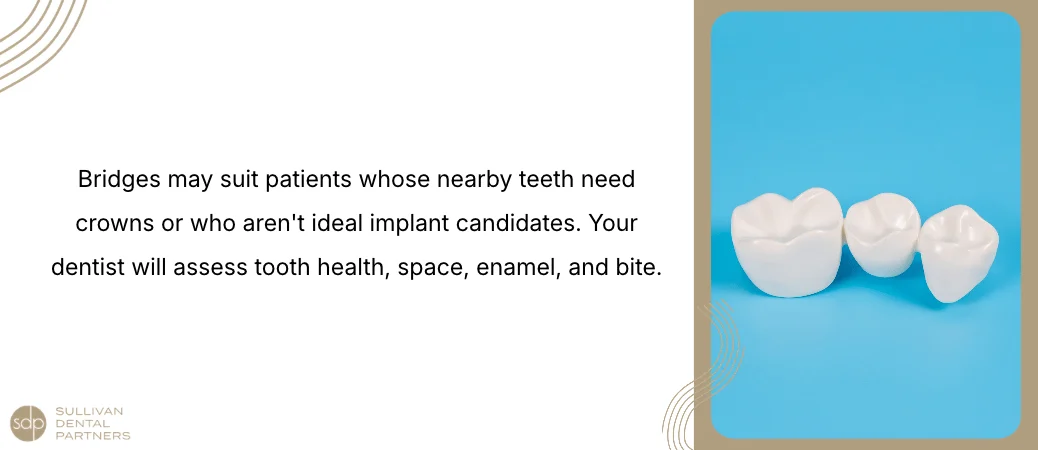
You may find a dental bridge suitable when the neighboring teeth already need crowns or when implant preparation would be extensive.
A conventional bridge uses supporting teeth to hold a replacement tooth across the gap.
Dental bridges require sound support and enough room for the replacement tooth. If your neighboring teeth are healthy and intact, ask how much tooth structure would need removal.
A resin-bonded bridge is another option in selected sites, especially toward the front of your mouth. Its suitability depends on your enamel and bite.
When Orthodontic Space Closure May Be Possible
Your orthodontist may recommend closing the gap completely by moving natural teeth into it. This approach is useful in selected bite patterns and missing-tooth locations.
You need an assessment of your full bite before choosing space closure. Treatment sometimes includes reshaping a tooth so its appearance and function suit its new position.
Ask what the final tooth arrangement would look like and whether you would need additional restorative work.
How a Temporary Partial Denture Can Cover the Gap
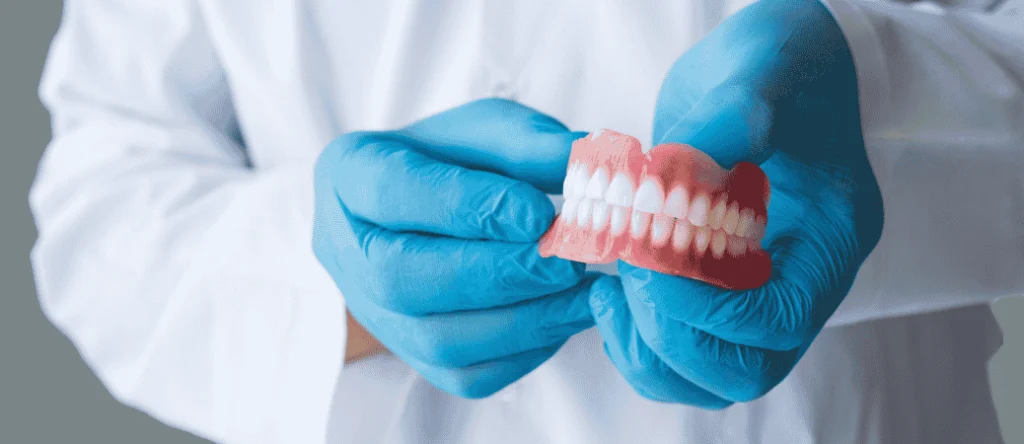
You can use a removable partial denture to cover the space during parts of your treatment. A small temporary partial denture is sometimes called a flipper.
Your appliance needs to fit around any planned tooth movement and protect a healing surgical site. Expect adjustments or replacement as the gap changes.
Ask which foods you should avoid while wearing it and when to remove it. Your temporary tooth should follow your treatment plan without interfering with correction or healing.
Start With a Space Assessment, Not an Assumption

Getting a single dental implant after teeth shifting may still be possible, but the right approach depends on the available space, neighboring root positions, bone support, and bite alignment.
A narrowed gap does not automatically rule out implant treatment.
At Sullivan Dental Partners, ask to review which measurements support your treatment plan and whether tooth alignment needs correction first.
Your implant candidacy also includes checking that your teeth and gums are healthy enough for the proposed care.
Request a written sequence covering any orthodontics, temporary tooth replacement, and implant restoration. You should know who will confirm the space is ready before surgery is scheduled.
Frequently Asked Questions
Your implant consultation should give you specific answers about clearance, costs, and temporary gap coverage. Use these questions to clarify the details of your own plan.
Can I still get an implant if my tooth has been missing for years?
You may still qualify for an implant after years without the tooth.
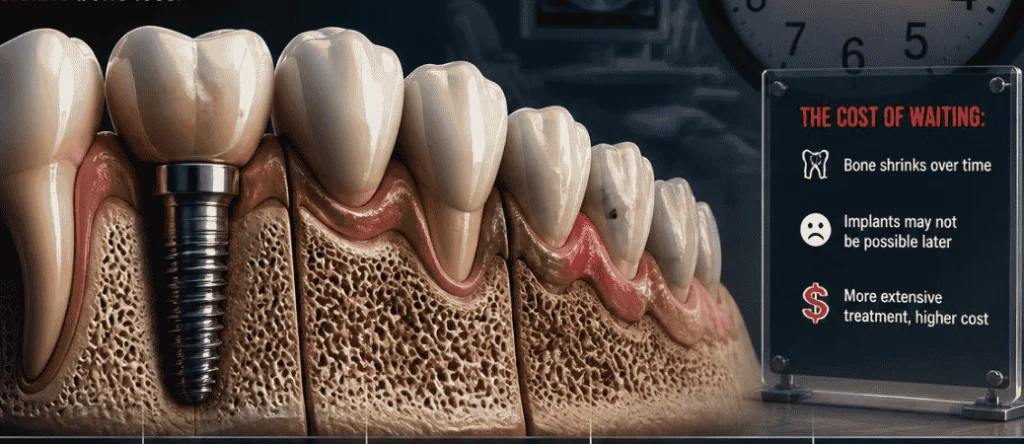
Your assessment checks current tooth positions and bone support; if the ridge has shrunk, bone grafting before a dental implant might be part of your preparation.
How far should an implant be from adjacent teeth?
A commonly cited planning guideline is approximately 1.5 mm of clearance between an implant and each adjacent natural tooth.
However, the space required depends on implant dimensions, neighboring root positions, bone anatomy, and the planned restoration. Your dentist will determine the appropriate measurements for your individual case.
How much does a single tooth implant cost if I need orthodontics first?
Your total cost includes the orthodontic treatment plus the implant restoration and any other necessary preparation.
When deciding whether implant treatment is worth the investment, request an itemized estimate covering imaging, tooth movement, retention, temporary coverage, surgery, the implant abutment, and the crown.
Ask which charges belong to each provider and whether any payment or financing options are available.
How can I cover the gap while waiting for orthodontics and an implant?
You may use a removable partial denture or a cosmetic replacement tooth built into an aligner or retainer.
Your team should choose coverage that allows the planned tooth movement and avoids pressure on healing tissues after surgery.
Can an implant push shifted teeth back into position?
Your implant will not straighten adjacent teeth or push them safely into place. You need controlled orthodontic movement when neighboring teeth require repositioning, with the required clearance confirmed before placement.